


How Do We Know The Male Elephants Are Thriving?
Blog by
Lisa Olivier,
GRI-Conservation Behaviour Advisor

Lisa is GRI's Conservation Behaviour Advisor. She uses 18 years of experience in elephant behaviour and field data across all stages of rehabilitation and release, turning this into practical insights and evidence that guide ranger decision-making. Her goal is to support both animal welfare and ranger-led conservation.

In recent months, we’ve celebrated some extraordinary moments amongst the female elephants — a new calf born into the wild, devoted allomothering behaviour, and matriarchs guiding their herds into safe areas of the landscape.
But you asked us an important question - how do we know that the released and wild male elephants are thriving too?
Male elephants follow a different path. Their milestones are often quieter, more wide-ranging, and less immediately visible, but they are no less important. Through long-term Post-Release Monitoring (PRM), we track these milestones carefully to understand not just whether male elephants survive, but whether they are truly living well in the wild.
Strong social bonds
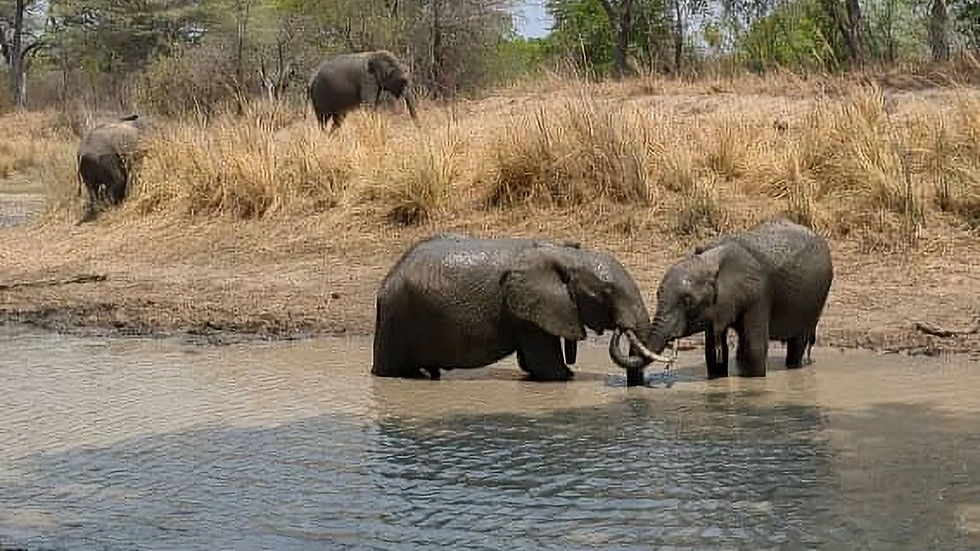
As young bulls mature, they often form loose bachelor groups. As they develop further, they will often seek longer-term mentoring relationships with older bulls. These social bonds may be fluid rather than constant, but they are essential for learning, confidence-building, and appropriate social behaviour.


Seeing bulls interact calmly — sparring, travelling together, or moving confidently between groups — is a strong indicator of psychological well-being and social competence. These interactions show that males are developing the skills they need to navigate the wider elephant society. Many of the released bulls leave and rejoin other released elephants frequently and even visit the orphan herd occasionally.
Exploring wide home ranges
As male elephants mature, they begin to roam more widely. This exploration is not random; it is how bulls learn landscapes, locate water sources, track seasonal forage and establish safe movement routes, and is known as “exploratory behaviour”.
During the latest monitoring period, released bulls Tafika and Muchichili each travelled over 1,200 kilometers, adjusting their movements in response to rainfall, vegetation growth, and surface water availability. Rufunsa also recently expanded his range, moving further south beyond the boundaries of Kafue National Park. These extensive movements indicate increasing confidence in independently exploring areas well beyond the Release Facility, alongside growing integration within wild elephant populations.
Such wide-ranging behaviour closely mirrors that of wild-born bulls and signals growing confidence and ecological competence.
Movement map of Muchi (green) and Tafika (red) during October-December 2025. Movement map of Rufunsa’s recent movements outside the south of KNP.
Positive interactions with wild herds
One of the clearest indicators of post-release success is how male elephants interact with others in the landscape. Calm, respectful encounters, such as responding correctly to social cues and moving fluidly through shared space, show that a bull fits naturally into the social environment.
Recent monitoring recorded overlapping movements between released and wild elephants along key corridors leading into the Ngoma Teak Forest. These corridors act as vital ecological pathways, connecting seasonal food resources and water sources and supporting shared use of the landscape by multiple herds and bachelor groups.
Increase in overlapping movements among Muso, Muchi, and wild herds (H5733, H5734 & H5735)
Healthy body condition
Thriving bulls show good muscle tone, clean skin, steady growth, and normal feeding behaviour. These physical markers tell us that an elephant is coping well with the demands of the landscape — finding sufficient forage, moving efficiently, and maintaining good overall health.
In some cases, growth itself becomes the clearest indicator of success. During the most recent quarter, Rufunsa required his GPS collar to be replaced not because of a technical failure, but because he had rapidly outgrown it. This kind of intervention reflects positive welfare outcomes and continued development since release.
Mphamvu in excellent body condition. Collar tracked via helicopter and his too-tight collar replaced.
Normal musth cycles

Although most released bulls are not yet old enough to show regular musth, it remains an important long-term indicator of release success. Musth is a natural hormonal state linked to reproduction and physical condition, and it typically becomes predictable only once males reach full maturity.
The oldest released bulls, Batoka (17 years 9 months) and Tafika (17 years 2 months), are at an age where only brief, low-intensity early musth episodes might be expected. Regular, sustained musth usually develops later, from around 25–30 years of age.
Because musth is energetically demanding, it does not occur in bulls in poor condition or under chronic stress. As a result, the future emergence of regular, well-timed musth will provide strong evidence that released bulls are maintaining good health, low stress levels, and full reproductive potential in the wild.
How we monitor success
These milestones are tracked through a combination of GPS collar data, real-time field monitoring by vehicle, and behavioural observations recorded using camcorders and drones where conditions allow.
Together, these methods allow our teams to understand not just where elephants are moving, but how they are behaving, whether they are confident, healthy, socially integrated, and adapting appropriately to life in the wild.
Kasi observing released eles via the drone
Every milestone matters
Female elephants play a vital role in shaping the future of herds, and their milestones deserve celebration. But bull milestones matter too. Independence, exploration, social competence, and physical development are all signs that a male elephant is not just surviving, but truly thriving back in the wild.
Through long-term Post-Release Monitoring, we are able to follow these journeys, learn from them, and ensure that every elephant has the best possible chance of a full, wild life.
Every elephant counts.


Comments